NIFTY 50
BANK NIFTY
What each index options call includes
How a typical index-options week looks
Index options research is structured around the weekly expiry. The arc runs from Monday's positioning read to expiry-day discipline, with the manual six-filter process applied each morning.
Monday (post-close)
Weekly positioning read
Friday's expiry settled — fresh weekly open interest builds across strikes. Highest OI on the call side marks supply (resistance bias); highest OI on the put side marks demand (support bias). Put-Call Ratio (PCR) at extreme readings is a contrarian flag. Sector ETFs and bank-vs-broad spread are read for divergence.
Tue – Wed (pre-market)
Six-filter pass on indices
Global cues → Nifty / Bank Nifty bias → sector internals (banking-heavy days favour Bank Nifty; broad-market days favour Nifty) → OI/PCR scan → multi-timeframe technical structure → red-team review. Setups that fail any filter are dropped.
~08:45 IST (publish day)
Research note published
When a setup clears all six filters, the note goes live: index, direction (CE / PE), strike, entry premium range, target premium, stop-loss premium, expected holding period, and the OI / PCR rationale that anchors the trade.
Market hours
Position management
Premium targets and stop-losses are managed on the option premium itself — not the index spot. Theta decay is real: an OTM option that goes nowhere for two sessions can lose 30–50% of premium just to time decay, which is why most research-note holding windows are short (1–3 sessions).
Expiry day (Tue / Thu, schedule per NSE)
Expiry-day discipline
Gamma is at its highest near expiry. A 0.5% move in the underlying can swing the option premium 50%+. This is the riskiest day to hold options. The default is to be flat by mid-session unless the research note specifically targets expiry-day momentum — and even then, with size halved.
Post-expiry review
What worked, what didn't
Every published expiry-week setup is logged against outcome. The OI/PCR reads that worked vs the ones that didn't are part of next week's positioning thesis. This loop is part of the SEBI-mandated 5-year research record.
How an OI / PCR rationale is built
A redacted illustrative example of how the rationale connects positioning data to a trade structure. Specific index, strike and premiums are omitted; the reasoning is the point.
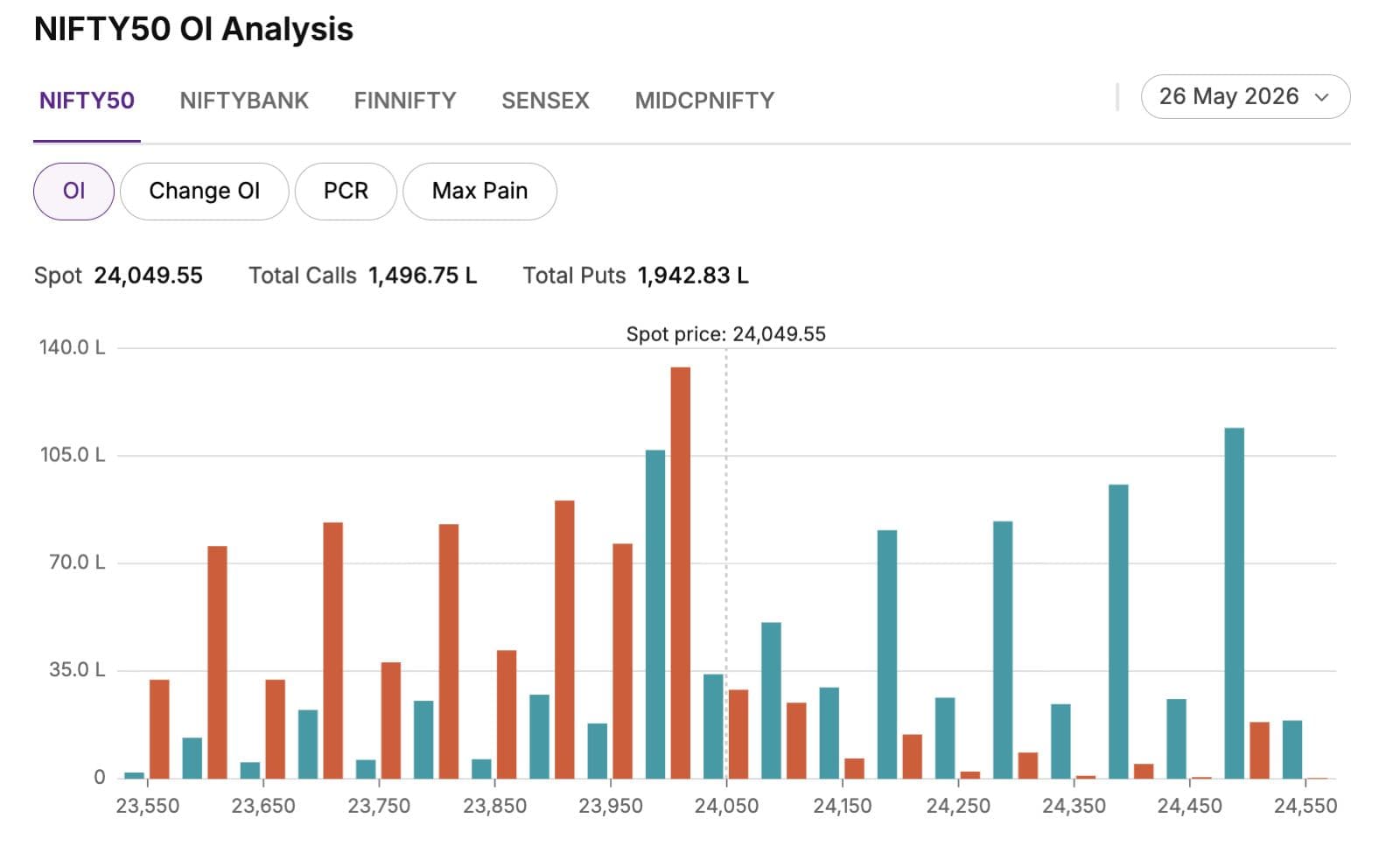
Sample rationale — illustrative only
Macro bias: Global cues neutral; no scheduled RBI / Fed event this week. Bank Nifty closed yesterday near multi-week resistance on rising volume.
OI build-up: Heaviest call OI sits ~2% above current spot; put OI is concentrated ~1.5% below. The asymmetric build favours a directional break if the spot pierces the call-OI wall.
PCR read: Weekly PCR at 0.85 — moderately bearish-positioned market, leaving room for a short-squeeze if direction flips up. Not extreme enough to be a strong contrarian signal on its own.
Technical confirmation: Bank Nifty hourly chart shows higher-low structure intact; daily RSI at 58, no bearish divergence. Direction bias for the week: cautious bullish above yesterday's pivot.
Trade structure: Buy a near-money weekly CE (ATM or 1-strike OTM) on a break above the previous session's high, with a defined premium stop-loss. Holding window: 1–3 sessions, exit before expiry-day gamma kicks in.
Red-team: If global cues sour overnight or banking sector breaks the higher-low, the trade fails. Premium stop = 30–35% below entry. Position sized so total premium-at-risk is 0.5–1% of account.
Published levels (illustrative only):
- Index / strike / type: [redacted] · weekly CE
- Entry premium range: ₹120 – ₹130
- Target premium 1: ₹165
- Target premium 2: ₹200
- Stop-loss premium: ₹85
- Holding window: 1–3 sessions
The above is a fully illustrative example — not a current recommendation. Index options are leveraged derivatives and can expire worthless, resulting in 100% loss of premium paid. Investments in securities markets are subject to market risk. Past performance is not indicative of future results.
Who index options research is for
It suits
- Traders who understand options pricing fundamentals — delta, theta, IV.
- Subscribers who size positions on total-premium-at-risk, not lot count.
- People who can exit on premium stop-losses without re-justifying losing trades.
- Hedgers using Nifty puts against an equity portfolio.
It does not suit
- First-time options traders — start with the [Bank Nifty vs Nifty guide](/blog/bank-nifty-vs-nifty-options-complete-guide-2026) and a paper account.
- Anyone who treats options as cheap lottery tickets — they expire worthless more often than not.
- Subscribers expecting fixed weekly profits — SEBI prohibits such promises, and the gamma profile of options makes them inappropriate for that framing.
- Traders who cannot honour a premium stop-loss when premium is decaying fast.
Risk-per-trade framework (illustrative)
Premium-at-risk of 1% on ₹5,00,000 capital = ₹5,000 maximum loss per index-options trade. If the research note's premium stop-loss is 30% below entry, the total premium that can be deployed is ₹5,000 / 30% = ~₹16,667 — divided across one or more lots of the named strike. Sizing this way means the worst-case outcome (premium goes to zero) still keeps the account-level loss inside the 1% budget. This is risk math, not a return projection.
Common questions about index options research
Are calls on Bank Nifty and Nifty published every week?
Only when setups clear the six-filter process. Some weeks the global cues, OI build-up or technical structure don't support a clean directional read — in those weeks the published count can be zero. "No trade this week" is a valid outcome of the methodology, and skipping mediocre setups is how the process maintains conviction on the ones that do publish.
Why does the research focus on buying options, not selling?
For retail subscribers, withSahib publishes buy-side index options structures — entry, target, stop-loss on the long premium. Maximum loss is capped at premium paid. Naked option selling has theoretically unlimited risk on calls and large risk on puts; the position-sizing math for retail accounts rarely justifies it. Defined-risk spreads are noted where appropriate.
How are stop-losses managed on options — by premium or by index level?
Premium. Index movement informs the premium move but is not the exit trigger. A research note will say "exit if premium falls to ₹85" — that is the trigger, not "exit if Nifty falls below 24,500". This keeps the stop framework consistent regardless of which strike or expiry the trade uses.
What's the practical impact of expiry-day gamma?
Near expiry, a small spot move produces a disproportionately large option-price move — both ways. An OTM option can go from near-zero to several multiples in minutes, then back down equally fast. Most withSahib index-options research notes plan to be flat before the expiry-day gamma window opens; expiry-day momentum setups are sized at half-the-normal allocation when published.
A thirty-minute conversation with Sahib. To understand if this is the right fit — for both sides.
30-minute strategy call — limited slots — SEBI Registered Analyst