Weekly CE/PE strategies
Near-the-money calls and puts with weekly expiry — each call defines an entry premium, target premium, and stop-loss premium on a defined-risk structure.
Monthly positional options
Longer-dated setups using monthly contracts. Lower theta decay pressure, suited for swing option strategies.
Strike & premium selection
Each call specifies exact strike, type (CE/PE), entry premium range, target premium, and stop-loss premium — no ambiguity.
Risk-defined setups only
All stock options calls from withSahib are buying strategies — maximum loss is limited to premium paid. No naked selling for retail subscribers.
Quarterly results plays
Options strategies around earnings — using IV expansion/contraction patterns and historical earnings move analysis.
SEBI-compliant disclosure
Every options call carries the SEBI registration number INH000026266, analyst disclosure, and mandatory risk disclaimer.
How a typical stock-options month looks
Stock options research is organised around the F&O monthly cycle and the results calendar. Each week brings a different blend of weekly-expiry plays and longer monthly setups; results season concentrates the highest-conviction opportunities.
Week 1 of expiry month
Universe scan
F&O-eligible NSE stocks (roughly 180–200 names) are scanned for setups. The six-filter process runs on the underlying — global cues, broad-market bias, sector rotation, stock scan, multi-timeframe technical, red-team review. Only when the underlying setup is clean does the options structure get layered on top.
Pre-results week (per stock)
Earnings-anchored setups
For F&O stocks reporting that week, historical earnings-move analysis is reviewed — average post-results gap, IV percentile entering results, post-results IV-crush pattern. A setup may target the pre-results IV expansion, the post-results IV-crush, or the directional gap. Each path has different strike-selection logic.
~08:45 IST (publish day)
Research note published
When a setup clears all six filters and the options structure is favourable, the note goes live: stock, strike, type (CE / PE), entry premium range, target premium, stop-loss premium, holding window, and the underlying-plus-options rationale.
Market hours · Day 1–N
Position management
Premium-based stop-loss and target. If T1 hits, partial profit is booked; the stop is trailed against the remainder. If the underlying breaks structure, the option position is closed even if the premium stop hasn't hit — pattern invalidation is the leading signal, premium is the lagging one.
2 days before expiry
Theta / gamma review
Open weekly positions are reviewed under accelerating theta decay. Positions that haven't moved in the trade's favour are typically closed — paying time decay on a stalled position is the worst outcome. Monthly positions get more time but the same discipline applies as expiry approaches.
Monthly expiry (last Thursday)
F&O monthly settlement
All open monthly positions are closed by morning of expiry to avoid settlement risk. The day is reviewed against the previous week: which structures worked, which IV reads were correct, what to carry into the next cycle.
How a stock-options rationale is built
A redacted illustrative example linking the underlying technical setup to the options structure. Stock name, exact strikes and premiums are omitted; the reasoning is the point.
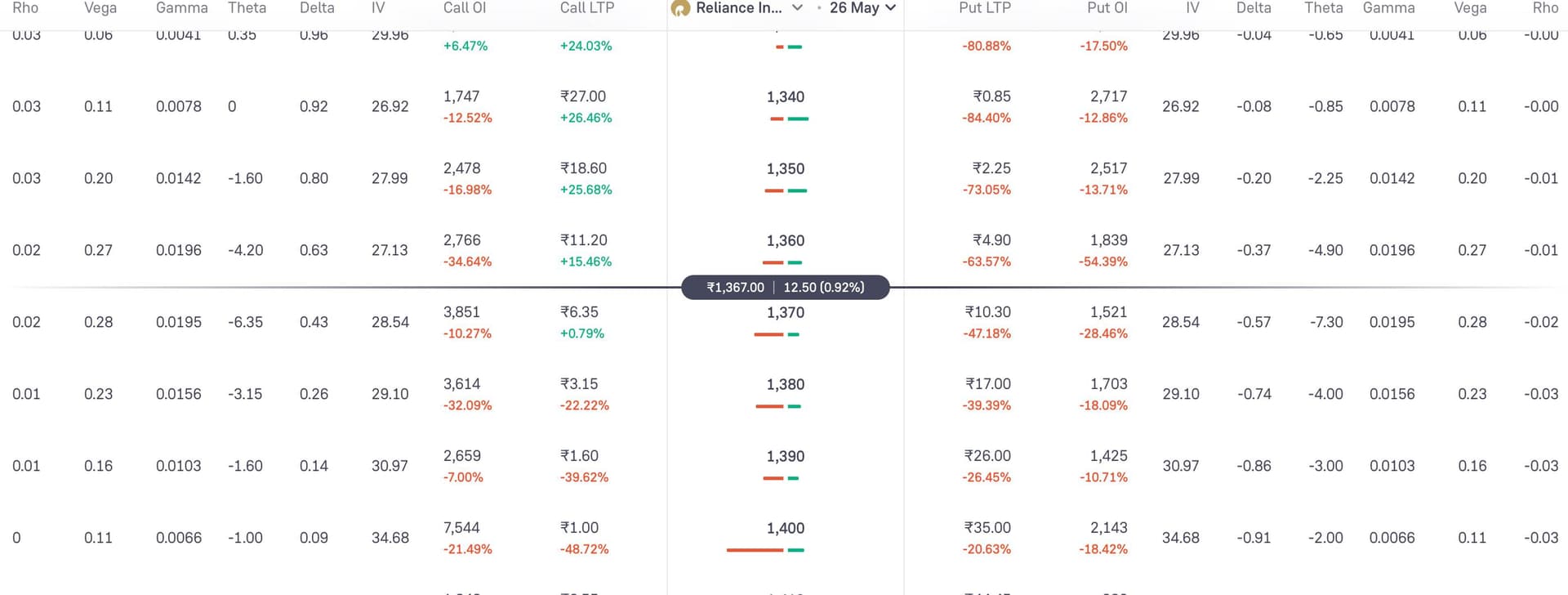
Sample rationale — illustrative only
Underlying setup: A large-cap F&O-eligible stock has formed a bull-flag on the daily chart after an 8% pole. Volume on the breakout candle confirms institutional participation. Daily and weekly timeframes agree on the direction.
IV context: Stock IV percentile is in the 35th percentile — below the median, premiums are reasonable. No earnings event scheduled inside the holding window, so no IV-crush risk. This is an IV-expansion-friendly setup.
Strike selection: ATM call (current-month expiry) selected. Delta ~0.55, theta manageable across 5 sessions. OTM would offer better leverage but a higher hit-rate requirement; ATM offers the cleanest trade-off for this setup.
Trade structure: Buy ATM CE inside the entry premium range. Target premium = +60% of entry (mapped from the underlying's measured move + delta translation). Stop-loss premium = -35% of entry (mapped from underlying invalidation level).
Red-team: Counter-thesis tested. If the underlying loses the 20-day EMA on a daily close, the pattern is broken and the trade is exited regardless of premium level — pattern invalidation leads the premium signal. Total premium-at-risk sized so worst case (premium → 0) is <1% of account.
Published levels (illustrative only):
- Underlying / strike / type: [redacted] · monthly ATM CE
- Entry premium range: ₹48 – ₹52
- Target premium 1: ₹78
- Target premium 2: ₹105
- Stop-loss premium: ₹32
- Holding window: 3–7 sessions
The above is a fully illustrative example — not a current recommendation. Options on F&O stocks are leveraged derivatives and can expire worthless, resulting in 100% loss of premium paid. Investments in securities markets are subject to market risk. Past performance is not indicative of future results.
Why withSahib publishes only buying strategies for stock options
For retail subscribers, withSahib publishes only buy-side stock-options structures — long calls and long puts. Maximum loss is capped at the premium paid. The published premium stop-loss is the worst-case exit level.
Naked option selling on single-stock F&O has theoretically unlimited risk on calls and very large risk on puts. The position-sizing math for typical retail accounts rarely justifies the structure. A 1% account-level risk budget can be wiped out by a single overnight gap on an uncovered short stock-call. Defined-risk spreads (bull call spread, bear put spread, etc.) carry capped risk and are noted where the setup specifically calls for them.
This is a position-sizing decision, not a view on which strategy is “better”. Institutional desks run sophisticated short-options books with full hedge frameworks. Retail accounts typically lack the margin headroom, hedging tools, and overnight monitoring to survive the tail risk of uncovered short options — so the published research stays on the buy side.
Common questions about stock options research
How many stock-options research notes are published per week?
Typically 1–3 per week, concentrated around clean underlying setups and earnings catalysts. Some weeks publish zero — if no F&O-eligible name has a clean six-filter setup with a favourable IV context, no note is published. Forcing trades during quiet weeks is how options accounts get bled by theta.
Are weekly or monthly contracts preferred?
It depends on the setup. Weekly contracts have faster theta decay but lower premium outlay — suited for sharp 1–3 session moves. Monthly contracts have lower theta pressure per session but higher absolute premium — suited for 5–15 session swing-options structures. Each research note specifies the expiry being traded.
What's the difference between trading the option vs trading the underlying?
Option premium is non-linear: delta, gamma, theta and vega all move the price. The same underlying move can produce wildly different premium outcomes depending on strike, expiry, and IV at entry. That non-linearity is why options research notes have a separate premium-based entry/target/stop framework rather than just translating the underlying levels directly.
How are earnings-week setups handled?
Pre-results, IV typically expands ahead of the event — a research note may target this IV expansion using ATM options closed before the announcement. Post-results, IV crushes sharply — short premium structures (defined-risk spreads) can capture the IV-crush move. Holding directional long-premium positions through results without a clear edge is usually a losing trade due to the IV-crush; the research notes are explicit about which side of the earnings event each setup targets.
A thirty-minute conversation with Sahib. To understand if this is the right fit — for both sides.
30-minute strategy call — limited slots — SEBI Registered Analyst