Intraday Research
Pre-market buy/sell levels with entry range, targets, and stop-loss. Published by 9:00 AM every trading day.
SEBI RA Sahib Singh Hora · INH000026266 · Not investment advice
What a call looks like
How a typical intraday session looks
The full pre-market-to-square-off arc, executed every NSE trading day. Each step is a manual analyst checkpoint — no automated buy/sell triggers.
06:00 – 06:30 IST
Global cues
Review SGX Nifty futures, US market close, Asian openings, crude oil and the dollar index. This sets the bias for the day — gap-up, gap-down, or neutral — and flags any overnight headline risk.
06:30 – 07:00 IST
Nifty bias
Analyse Nifty 50 futures using the previous day's candle, key support/resistance, and FII/DII data. Direction bias for the day is set — bullish, bearish, or rangebound.
07:00 – 07:30 IST
Sector rotation
Identify which NSE sectoral indices showed strength yesterday. The day's watchlist skews toward the strongest sectors — institutional money rotates between sectors, and individual names follow the sector tape.
07:30 – 08:15 IST
Stock scan (manual)
Roughly 1,500 NSE Main Board stocks are reviewed for liquidity, volume surge on the previous close, key technical levels and scheduled catalysts. This yields 20–30 candidates for deeper review.
08:15 – 08:45 IST
Multi-timeframe technical confirmation
Each candidate is checked across 15-minute, hourly, and daily charts. Entry is only justified when at least two timeframes agree. Then a red-team pass — every shortlisted setup is argued against. Setups that can't survive the counter-thesis are dropped.
~08:45 IST
Research note published
1–3 intraday research notes go live on the dashboard with full entry range, T1, T2, stop-loss, expected holding window and the written rationale. Pro subscribers receive a WhatsApp ping.
09:15 – 15:00 IST
Market open · position management
Published levels hold. Stop-losses are not loosened. Targets are not raised. If T1 hits, subscribers typically book partial profit and trail the stop to entry on the remainder. If SL hits, the trade is closed — period.
15:00 – 15:30 IST
Square-off discipline
All intraday positions are closed before 3:25 PM to avoid the broker's auto-square at unfavourable prices. NSE-registered brokers enforce auto-square between 3:15 and 3:25 PM; voluntary exit is almost always cleaner than waiting for it.
15:30 IST onwards
Review
The day's research is logged: which targets hit, which stop-losses triggered, what the market did versus what the research expected. This review feeds tomorrow morning's six-filter pass.
How an intraday research note is reasoned
A redacted, illustrative example of the rationale that accompanies a published intraday note. Stock name and exact levels are omitted; the reasoning structure is the point.
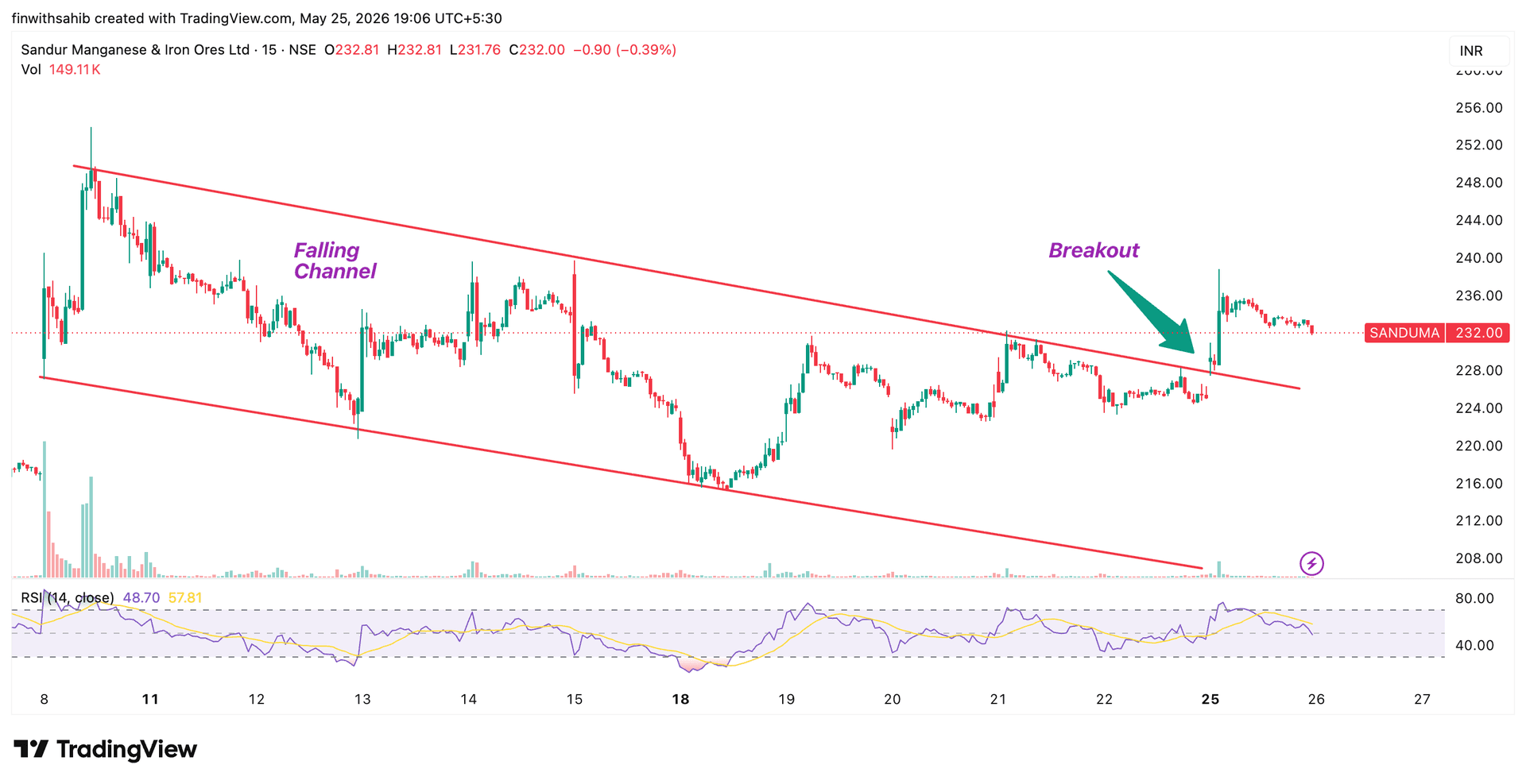
Sample rationale — illustrative only
Filter 1 · Global cues: SGX Nifty +0.4%, US closed mildly green, Asian markets neutral. Bias: cautious bullish, no headline event scheduled today.
Filter 2 · Nifty bias: Nifty 50 consolidating above the 21-day EMA after yesterday's wide-range bullish candle. Daily structure favours continuation.
Filter 3 · Sector rotation: Nifty IT broke a three-week base on volume yesterday — sector skew is constructive. Watchlist tilts to large-cap IT.
Filter 4 · Stock scan: A large-cap IT name closed near an eight-week resistance on 1.8× average volume. Daily candle bullish; 15-minute structure shows overnight accumulation.
Filter 5 · Multi-timeframe confirmation: 15-minute + hourly + daily all agree on direction. ATR-based stop-loss sits below the previous swing low — 0.6% from entry. T1 at the daily measured move (1.2%), T2 at the prior high (2.2%).
Filter 6 · Red-team review: Counter-thesis tested. Trade invalidates on an IT-sector reversal driven by US futures dipping pre-open. Position sized so a sector-wide 1% pullback simply triggers the stop, not the account.
Published levels (illustrative only):
- Entry range: ₹1,672 – ₹1,678
- Target 1: ₹1,695 (+1.2%)
- Target 2: ₹1,712 (+2.2%)
- Stop-loss: ₹1,665 (-0.6%)
The above is a fully illustrative example — not a current recommendation. Actual research notes name the stock, show the live chart, and carry the SEBI registration number on every dispatch. Investments in securities markets are subject to market risk. Past performance is not indicative of future results.
Who intraday research is for
It suits
- Traders who can be at a screen between 9:15 AM and 3:30 PM (or use bracket orders pre-market).
- Anyone comfortable with strict stop-loss discipline — exit on the level, not on hope.
- Subscribers sizing positions on a fixed risk-per-trade rule (typically 1–2% of capital).
- People who want accountable, SEBI-registered research with a written rationale on every call.
It does not suit
- Investors with a 6-month-plus horizon — see the Positional or Model Portfolio products instead.
- Traders who cannot watch markets during session hours and don't want to use bracket orders.
- Anyone who treats the stop-loss as optional.
- Subscribers expecting guaranteed daily profits. SEBI regulations prohibit such promises and no legitimate research can deliver them.
Risk-per-trade framework (illustrative)
Risk-per-trade of 1% on ₹5,00,000 capital = ₹5,000 maximum loss per trade. At a stop-loss distance of 0.6% on the stock, position size = ₹5,000 / 0.6% = ~₹8,33,333 worth of stock. Sized this way, even five consecutive losing trades — statistically possible in any methodology — produce only a ~5% drawdown. This is risk math, not a return projection. Investments in securities markets are subject to market risk; past performance is not indicative of future results.
Common questions about intraday research
How many intraday research notes are published per day?
Typically 1–3 notes per trading day — sometimes zero. The six-filter process is allowed to return "no trade today" when global cues, Nifty bias or sector context do not support a clean directional setup. "No trade" is a valid outcome of the methodology.
What happens if the stock opens above the published entry range?
It is skipped. Chasing entries beyond the published zone changes the risk-to-reward against the trader — the risk distance to stop-loss grows while the reward distance shrinks. The published level is the only acceptable entry; if the market doesn't come back to the zone, the trade doesn't happen that day.
Can I use bracket orders for intraday research notes?
Yes — and it's often the practical solution for working professionals. Most NSE-registered brokers support bracket orders that place entry, target, and stop-loss as a single linked order set. Place the bracket pre-market and let the broker manage execution during session hours.
Are intraday gains taxed differently from delivery trades?
Yes. In India, intraday equity trades are treated as "speculative business income" and taxed at the trader's applicable slab rate; delivery-based trades fall under capital gains. Consult a chartered accountant for your specific situation — the tax treatment can change the after-tax economics of an intraday strategy materially.
Want to learn the research process behind these notes? See the private mentorship programmes.
A thirty-minute conversation with Sahib. To understand if this is the right fit — for both sides.
30-minute strategy call — limited slots — SEBI Registered Analyst